A Georgia property manager dealing with active water intrusion needs a safe response plan now and a documented roof decision after the immediate condition is controlled. Those are related tasks, but they are not the same scope. A temporary measure may reduce further exposure while the owner, roofer, insurer, and other building professionals determine the permanent repair.
Evaluate commercial roofers by whether they confirm current availability, work within the building’s safety and access controls, document observations, define temporary work, and give the owner a supportable repair or replacement plan.
Integrity CRR is an Atlanta-based general contractor that self-performs roofing with its own crews and writes roofing estimates in-house in Xactimate. Response timing depends on location, weather, safe access, current workload, and the conditions reported. Property managers can call (833) 423-6255 or use the project request form to confirm availability for a specific building.
What Georgia Commercial Roofer Should a Property Manager Call?
Call a contractor that can answer these questions before anyone is sent onto the roof:
- Who is the owner’s response contact, and who will lead the site visit?
- What information is needed to evaluate urgency and safe access?
- Does the first authorization cover inspection only, temporary work, or a defined repair?
- How will roof observations, interior conditions, photographs, and quantities be recorded?
- What exclusions or limits apply to the initial visit?
- How will the contractor distinguish immediate protection from the permanent scope?
- What deliverable will support the owner’s repair, replacement, and capital-planning decision?
A clear answer does not guarantee a dispatch time or a particular repair. It gives the property manager a documented basis for authorizing the next step.
Put Life Safety and Building Controls First
Keep occupants and staff away from active ceiling leaks, wet electrical equipment, damaged ceiling materials, and any area where materials could fall. Use the building’s emergency, security, electrical, and facilities procedures before focusing on the roof itself. Do not send an untrained employee onto a wet or unfamiliar roof to find the source.
Roof access is a work-at-height activity. OSHA’s construction fall-protection standard addresses unprotected edges, holes and skylights, hoist areas, and low-slope roofing work. The contractor’s site plan should identify safe access, fall protection, roof openings, material-loading areas, and any work zone below the roof. Property managers should also disclose known roof hazards, restricted areas, rooftop equipment, and site-access rules before the visit.
Water appearing inside does not, by itself, prove where the roof entry point is located or what caused it. Interior observations, roof conditions, drainage paths, penetrations, and concealed materials may all require separate evaluation. The first visit should state what was observed and what remains unverified.
Document the Condition Before Permanent Work
From safe interior or ground-level positions, record:
- the time and location where water was first observed;
- affected rooms, inventory, equipment, finishes, and tenant operations;
- weather conditions reported at the site;
- prior leak or repair records for the same area;
- photographs or video taken before materials are moved, when it is safe to do so;
- temporary steps authorized and the person who authorized them; and
- invoices, receipts, correspondence, and contractor reports.
The Georgia Office of the Commissioner of Insurance and Safety Fire’s claim tips advise policyholders to understand their policy, notify the insurer within applicable time requirements, keep correspondence and expense records, photograph damage when possible, and distinguish temporary protection from permanent repairs before inspection. Coverage, notice duties, inspection requirements, and payment depend on the specific policy and the carrier’s review.
For a commercial building, the owner should also preserve lease notices, incident reports, maintenance logs, and communications with tenants or vendors. Those records can help the project team reconstruct what happened without turning an early observation into an unsupported cause statement.
Define the Initial Roof Authorization
An urgent call should still produce a written authorization. It can be short, but it should identify:
- the property and authorized contact;
- roof access and site restrictions;
- the inspection or temporary-work limit;
- the labor, materials, and equipment authorized;
- how additional work will be approved;
- the documentation the owner will receive; and
- whether the contractor is being asked to preserve removed materials or coordinate an insurer inspection.
Temporary protection may include a project-specific measure selected after safe access and observation. The right measure depends on the roof assembly, weather, surface condition, location of the opening, and the risk of making the condition worse. A general webpage cannot select that method for a particular roof.
The closeout for the initial visit should separate observed conditions, work performed, areas not accessed, limitations, and recommended next steps. It should not describe a concealed cause, remaining service life, code requirement, or insurance outcome as proven unless the available evidence supports that statement.
Turn the Site Record Into a Long-Term Roof Plan
After the immediate condition is addressed, a property manager needs a decision record that can survive budget review. A useful plan may include:
- A measured roof plan and inventory of roof areas, penetrations, drains, curbs, walls, and expansion joints.
- The known roof assembly and installation history, with assumptions labeled where records are missing.
- Observed membrane, flashing, drainage, deck, and interior conditions.
- Moisture investigation or roof cuts when justified, including the test method and its limits.
- Repair alternatives with defined quantities, details, exclusions, and expected maintenance needs.
- Recover or replacement alternatives supported by existing-condition findings, structural and attachment considerations, manufacturer requirements, and permit review.
- An occupied-building plan for access, loading, noise, odors, interior protection, tenant notices, rooftop equipment, and daily weather protection.
- Closeout requirements for photographs, inspection records, product data, maintenance information, and any warranty application.
This is where the lowest initial number can become difficult to compare. One proposal may exclude insulation, deck repair, drainage corrections, temporary protection, permits, or rooftop-equipment coordination that another proposal includes. Ask every bidder to price the same written basis and list its assumptions.
Budget With Scope Drivers, Not Generic Price Promises
A reliable commercial roof budget starts with the building, not a national per-square-foot range. Important cost drivers include:
- measured roof area and the number of existing roof layers;
- removal, disposal, and material-loading logistics;
- deck condition and areas of wet or damaged insulation;
- insulation, cover board, attachment, and tapered-drainage design;
- penetrations, curbs, walls, edge metal, drains, and overflow paths;
- occupied-space protection and work-hour restrictions;
- crane, lift, traffic-control, or restricted-access requirements;
- engineering, permit, inspection, and closeout requirements; and
- the exact manufacturer and contractor warranty documents requested.
Ask for base scope, alternates, unit prices for concealed conditions, and a written change-authorization process. If the owner needs phased capital planning, identify which assumptions would allow a repair phase to remain separate from a later replacement. The Atlanta commercial roof cost and bid worksheet shows how to compare those fields without treating an unsourced online range as a project budget.
For an occupied multi-tenant retail property, the Georgia shopping-center roof guide expands that framework into contractor verification, tenant and rooftop-equipment coordination, comparable bid scope, and closeout requirements.
Confirm the Code and Permit Path by Address
Georgia’s Department of Community Affairs publishes the current state minimum construction codes and Georgia amendments. Local administration and the applicable requirements still depend on the property’s jurisdiction and the proposed scope.
A contractor proposal should identify the property jurisdiction, the permit assumption, and any design or engineering information expected from the owner or design professional. A Metro Atlanta mailing address does not establish whether a city or county is the permitting authority. Code applicability, permit review, manufacturer requirements, and insurance coverage are separate determinations.
Use Xactimate as an Estimating Tool, Not a Coverage Decision
Verisk describes Xactimate as software for calculating and documenting property repair costs. It can organize measurements, repair operations, quantities, photographs, and pricing information into an itemized estimate. When another estimate uses corresponding line items, the two construction scopes can be compared more directly.
Integrity CRR writes its roofing estimates in-house in Xactimate. That is a construction-estimating function. The software does not determine cause, coverage, deductible application, accepted scope, or payment, and neither does the contractor.
If insurance may be involved, the property owner should follow the policy’s notice and documentation requirements and ask the carrier how it wants temporary and permanent work handled. Integrity CRR can document observed construction conditions and prepare an itemized construction proposal for the property owner. The owner can provide those materials to the carrier or ask how the carrier wants them delivered. Integrity CRR does not advise on policy rights, represent the owner, adjust, negotiate, or settle the claim.
Keep the construction scope separate from the carrier’s coverage decision. If the owner needs policy interpretation or claim representation, the owner should seek an appropriately licensed professional or legal counsel for that separate role.
Verify the Contractor Before Authorizing Work
The property manager’s file should include more than a logo and a phone number. Request:
- the exact legal entity and current contractor-license record;
- project-specific insurance and bonding documents when required;
- the person responsible for the site visit and written scope;
- the trades the contractor self-performs and those it subcontracts;
- current manufacturer eligibility for any proposed warranty program;
- references for comparable roof systems and occupied buildings;
- a sample inspection, repair, or replacement deliverable with private information removed; and
- written response, communication, change-order, and closeout procedures.
Integrity CRR is a Georgia-licensed commercial general contractor. Roofing is self-performed by Integrity CRR crews, and non-roof trades are managed through vetted subcontractors named in the proposal.
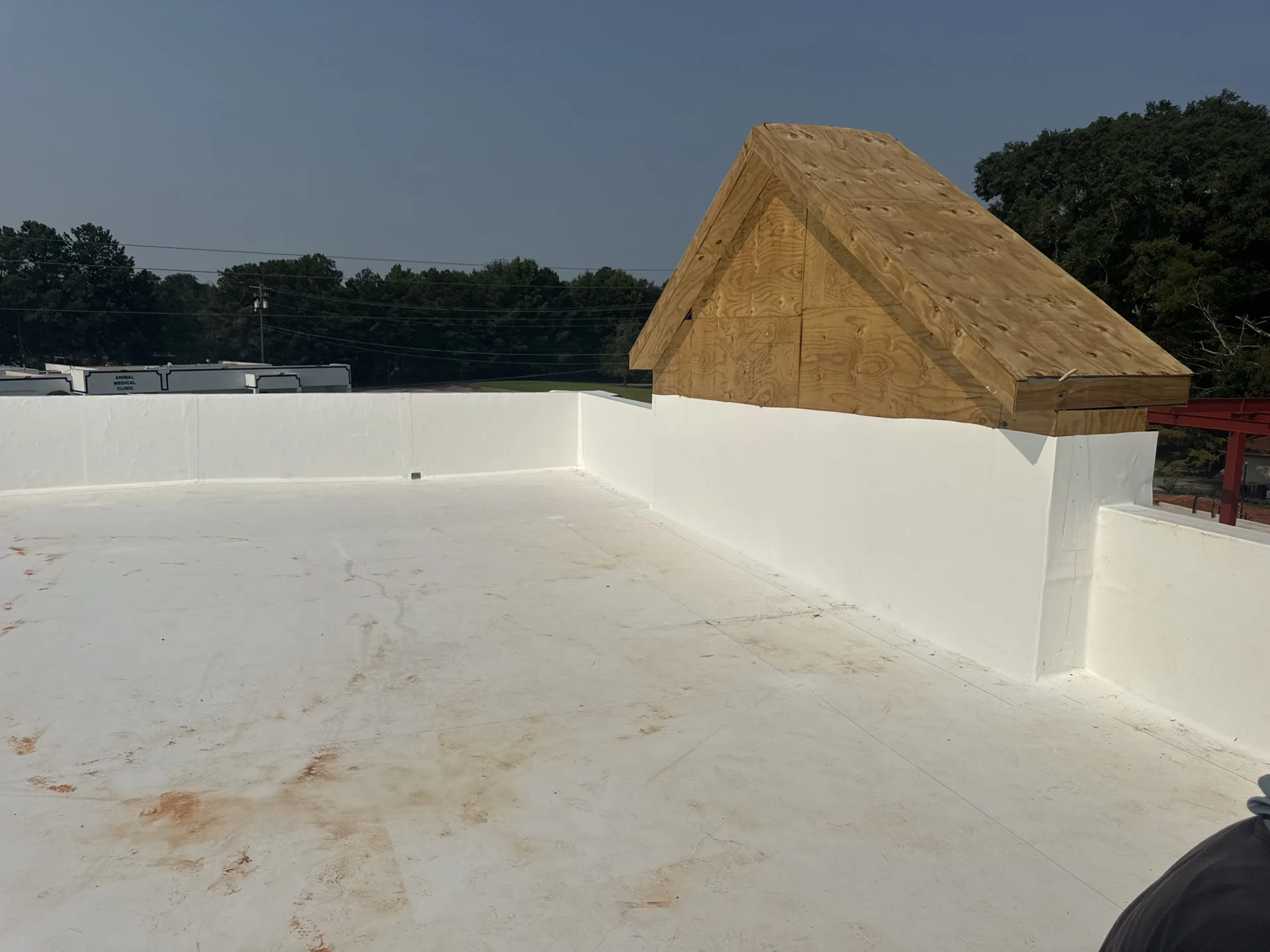
For installation-stage evidence, review the commercial TPO planning guide and project photography. The photographs document only the visible work stages. Response timing, building results, and warranty issuance require separate project records. The broader commercial roofing service page explains the systems Integrity CRR works with.
Frequently Asked Questions
Who should a Georgia property manager call for an active commercial roof leak?
Call a commercial roofer that will confirm current availability, define the initial authorization, work within the site’s safety and access controls, document observed conditions, and separate temporary protection from the permanent repair. Integrity CRR can be reached at (833) 423-6255, but timing depends on location, weather, safe access, workload, and the reported conditions.
Can a commercial roofer guarantee same-day response?
A webpage should not make that guarantee. Availability depends on the specific location, weather, safe roof access, crew and material availability, current commitments, and the condition being reported. Ask the contractor to confirm timing and the authorized first-visit scope in writing.
What should a property manager document before temporary roof work?
When it is safe, record where and when water appeared, affected spaces and operations, photographs or video from safe positions, prior repair history, communications, temporary measures, invoices, and receipts. Follow the policy’s notice requirements and preserve materials or conditions the carrier asks to inspect.
What belongs in a long-term commercial roof replacement plan?
The plan should identify the existing assembly, measured roof areas, observed conditions, investigation limits, repair and replacement alternatives, drainage and detail work, occupied-building controls, code and permit assumptions, proposal exclusions, and closeout or warranty documents.
Does an Xactimate estimate decide what an insurer will cover?
No. Xactimate is an estimating platform. It can organize a contractor’s repair scope and pricing, but the policy and carrier review determine coverage, accepted scope, deductible application, and payment.
Can a contractor negotiate a Georgia property claim for the owner?
Integrity CRR does not do so. It documents observed construction conditions and prepares an itemized construction proposal for the property owner. The owner decides whether and how to provide those materials to the carrier. If the owner needs policy advice or claim representation, the owner should seek an appropriately licensed professional or legal counsel for that separate role.
How can an owner verify Integrity CRR’s Georgia license?
Search the Georgia Secretary of State’s license lookup for company license GCCO009212 or qualifying-agent license GCQA009212.
Managing an active leak or planning a commercial roof replacement? Call (833) 423-6255 or send the property address, roof information, observed conditions, and access constraints so Integrity CRR can confirm current availability and the appropriate next step.