
Thermoplastic polyolefin (TPO) can be a suitable low-slope roof membrane for an Atlanta commercial building, but the membrane is only one part of the decision. A useful proposal should document the existing roof, deck and moisture conditions, attachment method, insulation and drainage design, perimeter and penetration details, permit path, and the exact warranty process. Those project-specific facts determine whether a recover, tear-off, repair, or different roof system makes sense.
What the Field Photograph Shows
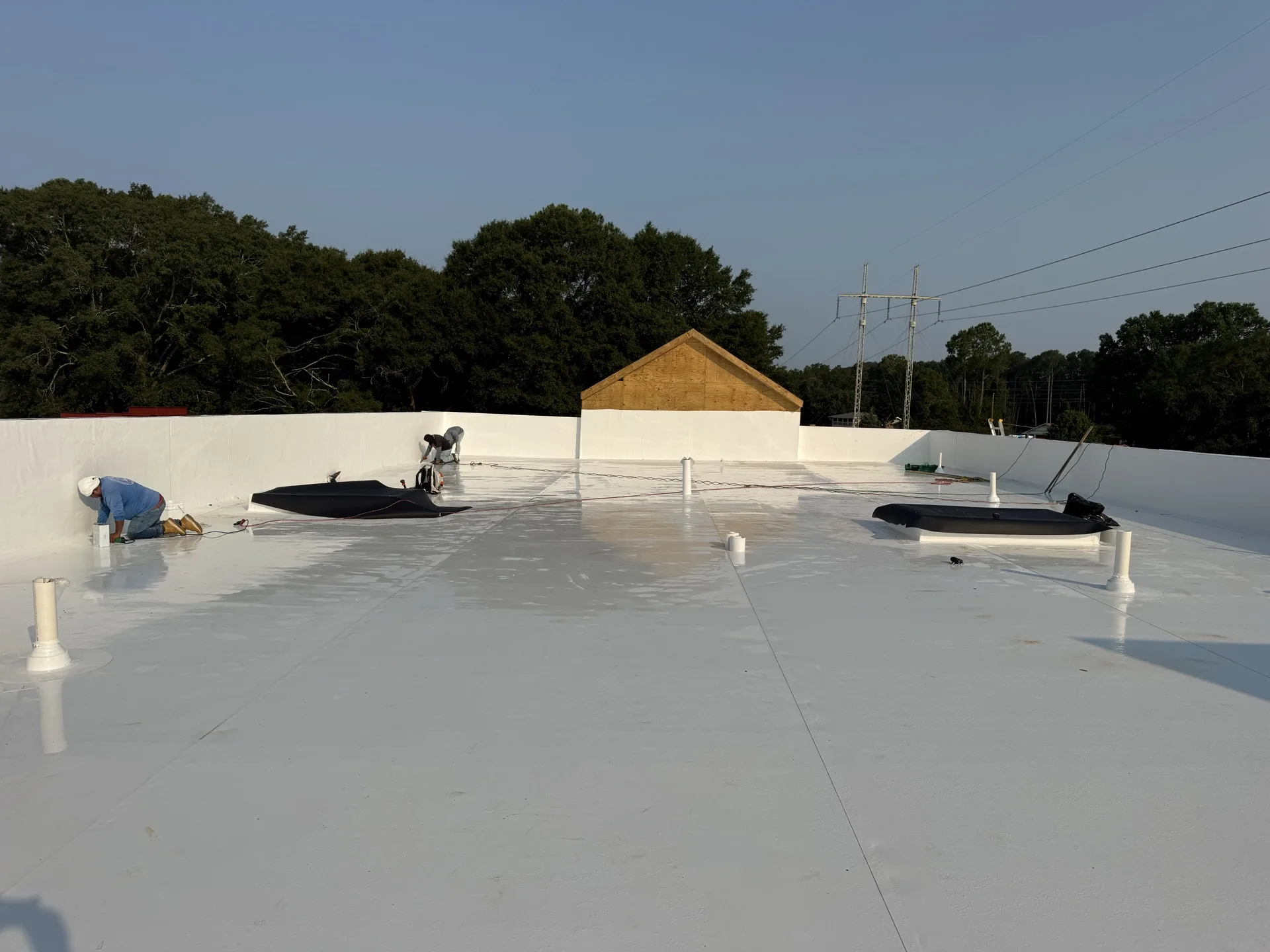
The project photograph above shows white single-ply field membrane, vertical perimeter work, roof penetrations, and installers working during an active roofing stage. The client and precise location are withheld.
A photo shows the visible surface. The membrane thickness, attachment method, insulation, seam testing, and warranty live in the approved submittal and project records, which is why a proposal matters more than a portfolio photo.
Start With the Existing Roof and Building
Before selecting a new assembly, document what is already there. Depending on the building and proposed work, the investigation may include record drawings, roof cuts, moisture testing, deck observations, drainage review, and a measured roof plan. The resulting record should support the design and bid with verified conditions rather than assumptions.
Questions to resolve include:
- How many roof assemblies or covering layers are present?
- Is moisture suspected in insulation or at the deck?
- What deck type and fastening conditions are present?
- Where does water drain, and are ponding or overflow conditions visible?
- Which curbs, drains, walls, penetrations, and rooftop units need new details?
- Will occupied areas, tenants, deliveries, or rooftop equipment constrain staging?
These are construction questions. They do not determine insurance coverage, and a photograph alone does not answer them.
Recover Versus Tear-Off
A recover places a new roof assembly over qualifying existing construction. A tear-off removes some or all of the existing assembly before new work begins. Neither choice is automatically correct.
GAF’s commercial recover guidance explains that the condition of the existing roof is central to whether a recover may be appropriate. The project team also has to account for moisture, deck condition, loading, attachment, drainage, manufacturer requirements, current code, and the local authority’s permit review.
Ask each bidder to state what evidence supports the recommended path. A proposal that simply says “recover” or “tear-off” without identifying the existing-condition assumptions is difficult to compare and more likely to produce scope changes later.
Compare the Whole TPO Assembly
Manufacturers publish multiple TPO configurations rather than one universal system. For example, Mule-Hide’s TPO submittal packages include fully adhered, mechanically attached, and induction-welded configurations for new construction or reroofing. The correct selection depends on the roof, specification, approvals, and project conditions.
Use an itemized comparison like this:
| Decision | What the proposal should identify |
|---|---|
| Existing conditions | Roof layers, observed moisture or testing limits, deck assumptions, and areas excluded from investigation |
| Attachment | Fully adhered, mechanically attached, induction-welded, or another approved configuration, with the supporting design basis |
| Insulation and cover board | Product type, thickness, layout, attachment, tapered areas, and transitions |
| Drainage | Drains, scuppers, overflow paths, tapered design, and any unresolved ponding conditions |
| Details | Curbs, penetrations, walls, expansion joints, edge metal, and tie-ins to adjacent work |
| Occupied-building plan | Access, material loading, temporary protection, noise or odor controls, and daily dry-in responsibilities |
| Closeout | Required inspections, submittals, photographs, maintenance information, and warranty application documents |
Membrane thickness and brand matter, but they should not distract from omitted insulation, drainage, edge, penetration, or occupied-building work.
If the shortlist includes more than TPO, use the TPO, EPDM, and PVC comparison guide to evaluate building use, exposures, rated properties, tested approvals, bid scope, and warranty documents without treating one membrane category as the universal answer.
Heat-Welded Seams and Detail Work
TPO field laps and non-self-adhered flashing components in a selected system use heat-welded seams. The equipment, temperature, speed, preparation, and detail geometry are part of the installer-controlled process. The approved specification, system manual, details, and project-specific approvals should be read together; GAF’s current mechanically attached TPO/PVC manual is one example of that level of system documentation.
A bid should explain how field seams, perimeter conditions, curbs, drains, penetrations, and transitions will be documented and reviewed. Avoid assuming that a white finished surface proves every concealed layer or detail meets the selected system requirements.
Reflectivity Without an Energy-Savings Promise
White roofing can reflect more solar energy than a dark roof. The U.S. Department of Energy’s cool-roof guidance also cautions that actual savings depend on factors such as climate, insulation, roof type, and heating and cooling efficiency.
That means “white membrane” is not a responsible utility-savings guarantee. If energy performance is a project goal, compare the proposed roof’s rated properties and insulation design with the building’s actual conditions and energy model or engineering analysis.
Atlanta Codes, Permits, and Local Authority
Georgia’s mandatory construction codes apply statewide whether or not they are locally enforced. The Georgia Department of Community Affairs lists the current state minimum codes and amendments and explains that a local government must adopt administrative provisions when it chooses to administer and enforce those codes.
For property inside the City of Atlanta, the Department of City Planning administers zoning and building-code review through its Zoning, Development, and Permitting Services. A “metro Atlanta” mailing address does not establish the permit authority. Confirm the property jurisdiction and proposed scope before relying on a permit assumption.
Code and permit requirements are separate from an insurer’s coverage decision and separate from a manufacturer’s warranty requirements.
Read the Warranty Documents Before Award
“Manufacturer warranty” can refer to different documents with different covered components, durations, inspections, exclusions, maintenance duties, and application requirements. Mule-Hide publishes sample commercial warranty documents, which illustrates why the actual form and system eligibility should be reviewed rather than summarized as a marketing promise.
Before signing, ask for:
- The proposed warranty type and sample form.
- The exact assembly and products intended to qualify.
- Required manufacturer or third-party inspections.
- Exclusions, maintenance duties, and owner notice requirements.
- Who submits the application and what closeout records the owner receives.
Only the issued warranty controls its coverage. A contractor proposal should not imply that a photograph, brand name, or certification alone guarantees issuance.
A Practical Bid Review
For an occupied commercial building, compare proposals line by line and write down every assumption. Clarify roof access, staging, temporary protection, weather response, rooftop equipment coordination, daily cleanup, change-order documentation, and closeout deliverables. Use the Atlanta commercial roof budget guide and its downloadable worksheet to separate base scope, alternates, allowances, unit prices, exclusions, and owner costs. Owners of multi-tenant retail properties can use the Georgia shopping-center roof guide to structure contractor verification, tenant controls, and a comparable bid package. If a broader commercial renovation changes curbs or penetrations, coordinate that work with the roofing scope before field installation.
Integrity CRR’s commercial roofing service covers TPO and other low-slope systems. The Projects gallery shows the same anonymous installation-stage photography with the same evidence limits.
Frequently Asked Questions
Is TPO right for every commercial roof in Atlanta?
No. TPO is one low-slope option. Existing conditions, deck type, drainage, attachment design, building use, rooftop contaminants, code, budget, and warranty requirements can support TPO or point to a different assembly.
Can TPO be installed over an existing roof?
Sometimes. A recover depends on the existing assembly and condition, moisture and deck findings, structural and attachment considerations, current code, local permit review, and manufacturer requirements. A building-specific assessment should support the recommendation.
Does a white TPO roof guarantee lower utility bills?
No. A reflective roof can reduce solar heat gain, but actual energy savings depend on climate, insulation, building operation, and HVAC performance. Review rated product data and project-specific energy assumptions.
How should an owner compare commercial TPO bids?
Compare the complete assembly and work plan: existing-condition assumptions, removal or recover scope, attachment, insulation, drainage, details, occupied-building controls, inspections, closeout records, and warranty documents. Do not compare only membrane brand or price.
Does a TPO installation automatically receive a manufacturer warranty?
No. Eligibility, inspections, application steps, covered components, exclusions, and issuance depend on the selected manufacturer and warranty program. Ask for the sample form and the issued closeout document.
Does a commercial roof project in Atlanta require a permit?
Permit requirements depend on the property jurisdiction and work scope. Confirm the address and proposed work with the City of Atlanta or the correct local authority before construction begins.
Planning a commercial low-slope roof? Send the existing roof information, drawings, known leak or drainage history, and access constraints with your estimate request, or call (833) 423-6255.