
A warehouse roof replacement in Norcross should begin with documented existing conditions and an operations plan, not a generic price per square foot or a promised completion date. The useful questions are whether the roof can be repaired or recovered, what must be removed, how the new assembly will be designed, which authority reviews the work, and how the building will remain protected while occupied.
This guide gives warehouse owners, property managers, and facility teams a bid-review framework. A building-specific investigation, approved scope, permit review, manufacturer requirements, and written contract control the actual project.
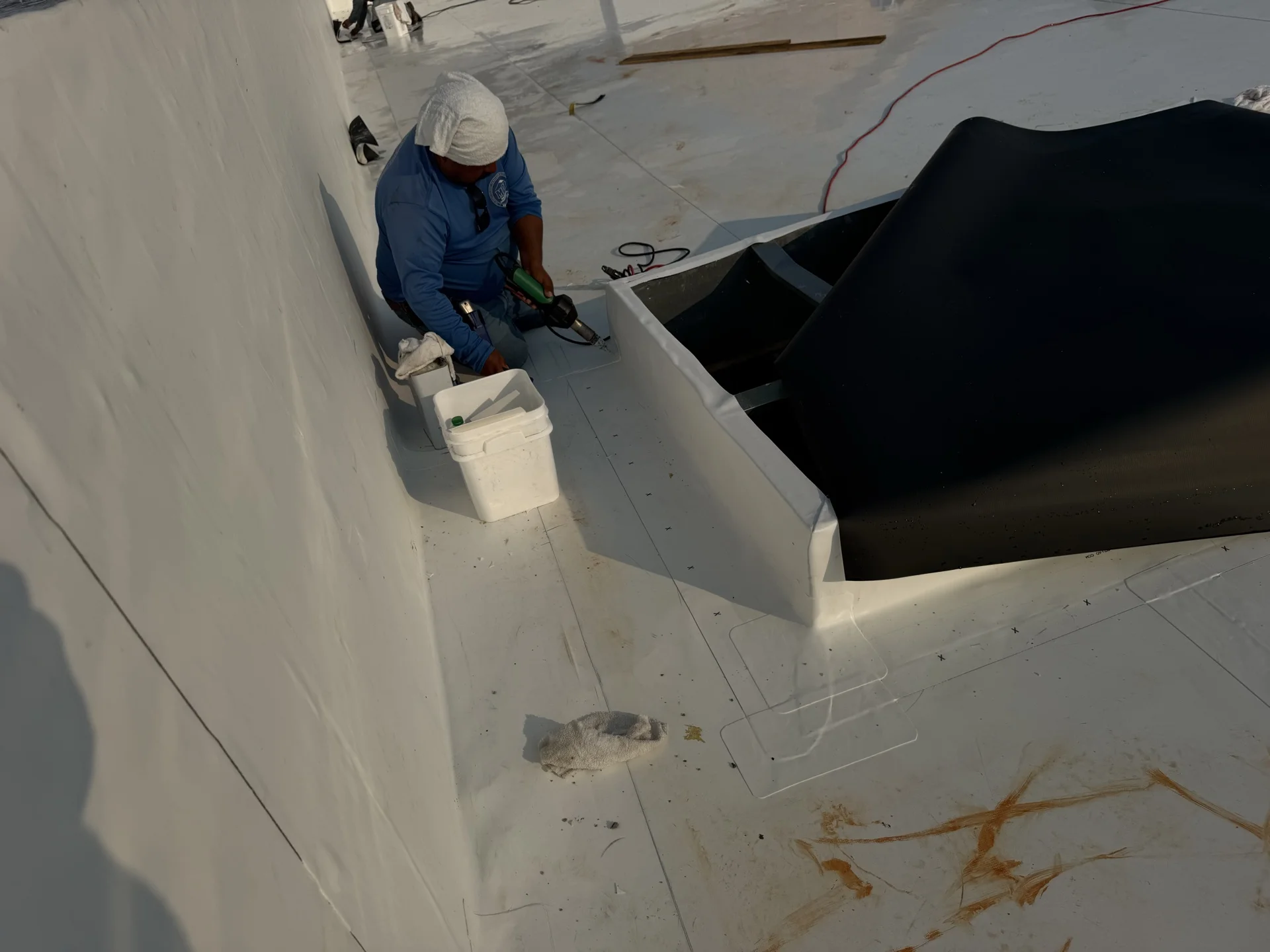
What the Field Photograph Establishes
The photograph above shows a technician using hot-air welding equipment at a penetration during an active white single-ply membrane installation. It comes from Integrity CRR’s project library and shows the process, not a Norcross warehouse project.
The image cannot establish the membrane manufacturer or polymer, thickness, attachment below the visible surface, insulation, deck condition, completed seam testing, final acceptance, or warranty issuance. Those facts require the approved submittal, field records, closeout documents, and issued warranty.
Start With Repair, Recover, or Tear-Off
Those are three different scopes:
- Repair addresses defined defects while retaining the surrounding roof.
- Recover places a qualifying new assembly over portions of the existing roof that remain in place.
- Tear-off and replacement removes the existing assembly to the extent required by the design, code, manufacturer, and observed conditions.
GAF’s commercial roof-recover guidance identifies existing roof count, structural condition, moisture or deterioration, and upgrade requirements as recover considerations. It recommends core cuts when evaluating insulation and other layers. That guidance illustrates why age or visible leakage alone cannot select the scope.
Ask each bidder to state the evidence behind its recommendation:
| Decision input | What should appear in the proposal or investigation record |
|---|---|
| Existing assembly | Known roof layers, membrane type, insulation, cover board, and deck assumptions |
| Moisture | Test method and limits, test locations, findings, and areas not evaluated |
| Deck | Known deck type, visible deterioration, access limits, and unit-price treatment for concealed repair |
| Drainage | Drains, scuppers, overflow paths, ponding observations, and proposed tapered work |
| Details | Curbs, walls, penetrations, edge conditions, expansion joints, and tie-ins |
| Recommendation | Why repair, recover, coating, partial replacement, or tear-off fits the documented conditions |
A bidder should label concealed conditions as assumptions or allowances until authorized work exposes them. A low base number that silently assumes dry insulation and sound deck is not comparable with a bid that prices known removal and replacement.
Plan Around an Occupied Warehouse
Warehouse operations can affect the roofing plan as much as the membrane selection. Before award, identify tenant hours, loading-dock schedules, sensitive inventory, production zones, interior clear heights, roof access, rooftop equipment, and any area where debris, vibration, odor, or water would create an unusual risk.
Require a written occupied-building plan that covers:
- Work zones and the maximum area that may be opened at one time.
- Weather thresholds and who can stop or resequence work.
- Temporary protection and daily dry-in responsibilities.
- Interior protection for inventory, equipment, ceiling systems, and active work areas.
- Material-loading, crane, delivery, and waste-removal routes.
- Coordination for docks, employee entrances, fire lanes, and tenant access.
- Rooftop-unit, curb, conduit, pipe, and communications-equipment responsibilities.
- The contact and escalation path for an unexpected opening or water event.
Do not convert that plan into an unsupported promise that every warehouse can remain fully operational. Some phases may require temporary access restrictions, equipment shutdowns, interior protection, or schedule changes. The contractor and owner should agree on those constraints before tear-off begins.
Roof access is also a safety decision. OSHA’s construction fall-protection resources collect the applicable standards and roofing guidance. Weather, access, roof edges, openings, equipment, and the selected work method can change when work may proceed safely; a marketing deadline does not override the site-specific safety plan.
Compare the Complete Roof Assembly
“TPO roof” is not a complete specification. Manufacturers publish multiple configurations with different attachment, insulation, cover-board, flashing, and approval requirements. Mule-Hide’s pre-packaged TPO submittals, for example, separate fully adhered, mechanically attached, and induction-welded systems for new construction and reroofing.
For every bid, compare:
| Scope category | Questions to resolve before you sign |
|---|---|
| Removal | What is removed, retained, tested, and disposed of? |
| Attachment | What method and project-specific design basis apply in field, perimeter, and corner zones? |
| Insulation and cover board | Which products, thicknesses, layers, tapers, attachment, and transitions are included? |
| Membrane | Which manufacturer, product, thickness, color, and configuration are proposed? |
| Flashing and edge work | Which curbs, penetrations, walls, drains, scuppers, edge metal, and expansion joints are included? |
| Rooftop equipment | Who disconnects, raises, resets, or replaces affected units and accessories? |
| Quality records | Which inspections, photographs, tests, punch-list records, and closeout documents are delivered? |
| Warranty | Which sample form, eligibility requirements, inspections, exclusions, maintenance duties, and application steps apply? |
Approved system instructions should govern installation details. GAF’s mechanically attached TPO/PVC systems manual is one example of the detail level that a system manual contains. It should not be treated as the specification for a different manufacturer or attachment method.
TPO, PVC, EPDM, or Another System?
No membrane is the automatic warehouse choice. Building use, existing construction, drainage, rooftop contaminants, attachment design, traffic, maintenance capability, approvals, and warranty goals all matter. The TPO, EPDM, and PVC comparison guide provides a side-by-side procurement framework for that shortlist.
- TPO and PVC use heat-welded field seams in their selected systems, but they are different materials with different product and exposure considerations.
- EPDM is another single-ply option with its own seam, flashing, attachment, and maintenance requirements.
- Coatings, modified-bitumen, built-up, and metal systems may remain relevant when the existing construction and project goals support them.
If solar reflectivity is part of the business case, avoid promising a utility-bill result from membrane color alone. The U.S. Department of Energy’s cool-roof guidance explains that actual savings depend on climate, insulation, roof type, and heating and cooling efficiency.
Norcross and Gwinnett Permit Jurisdiction
A Norcross mailing address does not by itself prove that the property is inside City of Norcross limits. The City’s own business-license guidance tells applicants to confirm whether an address is within city limits and directs properties outside the city to Gwinnett County.
For property inside the city, Norcross provides an online permit application and plan-submittal page. Its published commercial building permit application expressly includes reroof work and requests the work area, construction cost, scope, plans, licensing, and related project information.
For property under county jurisdiction, Gwinnett County Building Services handles commercial construction permitting and inspections. Confirm the physical parcel, authority, and exact scope before selecting a permit path.
Georgia’s current state minimum construction-code page identifies the currently adopted code editions and Georgia amendments. The governing code, local administration, manufacturer instructions, existing building, and proposed work determine the project requirements. Neither a mailing address nor an insurance estimate settles those construction questions.
Build a Defensible Budget Without a Generic Price Claim
There is no responsible universal warehouse-roof rate. Two roofs with the same plan area can have different removal, deck, insulation, drainage, access, equipment, phasing, and warranty scopes. A published price band without those assumptions can make unlike proposals look comparable.
Use a measured cost schedule instead:
| Cost component | Bid treatment to request |
|---|---|
| Base roof areas | Measured quantities tied to a roof plan |
| Removal and disposal | Separate quantities by existing material or layer where known |
| Concealed deck work | Defined unit prices, measurement rules, and written authorization process |
| Insulation and cover board | Product, thickness, quantity, taper, and attachment broken out |
| Drainage and details | Itemized drains, scuppers, curbs, penetrations, edges, and transitions |
| Operations controls | Interior protection, off-hours restrictions, temporary access, and special phasing |
| Equipment and logistics | Crane, loading, lifts, traffic control, rooftop-unit work, and disposal routes |
| Permits and design | Stated inclusions for fees, drawings, engineering, inspections, and revisions |
| Warranty and closeout | Application, inspection, documentation, and maintenance handoff |
| Alternates | Clearly separated recover, tear-off, thickness, cover-board, or warranty options |
Ask bidders to use the same baseline scope and identify every allowance and exclusion. That produces a useful capital-planning number and makes later changes auditable.
Use a Schedule Based on Production Assumptions
A fixed “two-to-four-week” promise is not meaningful without roof area, removal depth, crew plan, weather assumptions, material availability, equipment coordination, inspection points, and occupied-building restrictions.
Request a schedule that shows:
- submittals, material release, permit review, and mobilization;
- work zones and assumed daily production;
- rooftop-equipment and other-trade coordination;
- required inspections and manufacturer visits;
- weather and dry-in assumptions;
- substantial completion, punch work, and closeout;
- the process for revising the schedule after concealed conditions are documented.
The owner can then test the schedule against shipping peaks, tenant commitments, inventory sensitivity, and capital deadlines before work begins.
Review the Warranty Before Selecting the Bid
Warranty labels are summaries, not the warranty itself. Coverage, eligible assemblies, inspections, exclusions, maintenance, notification, transfer, duration, and remedies vary. Mule-Hide publishes sample commercial warranty documents, showing why the actual form should be reviewed before you sign.
Ask who submits the warranty application, what inspections are required, which closeout records the owner receives, and what later rooftop work must be reported. Only the issued document establishes the warranty that applies to the project.
What Integrity CRR Can Document
Integrity CRR self-performs roofing with its own crews and prepares roofing estimates in-house. For non-roof scopes, the company acts as general contractor and manages vetted subcontractors. The commercial roofing service page explains that operating model, while the Atlanta TPO planning guide covers attachment, drainage, reflectivity, and warranty review in more detail.
The Projects library contains original field photographs with explicit evidence limits. Send the roof plan, known leak history, prior repair records, available warranty, access restrictions, and operating schedule with an estimate request so the initial discussion starts with the building rather than a generic system or price.
Frequently Asked Questions
How do I know whether a warehouse roof needs replacement?
Document the existing assembly, leak and repair history, moisture findings, deck observations, drainage, details, and remaining service constraints. Those findings may support repair, recover, coating, partial replacement, or tear-off; age alone does not decide.
Can a warehouse roof be recovered instead of torn off?
Sometimes. A recover depends on the existing roof count and condition, moisture and deterioration findings, deck and structural considerations, attachment, current code, local permit review, manufacturer requirements, and project goals. Ask the bidder to show the evidence behind the recommendation.
Can the warehouse remain open during roof replacement?
It may be possible to maintain some or most operations with planned work zones, temporary protection, safe access controls, equipment coordination, and daily dry-in procedures. The answer is building- and phase-specific; the contract should identify any shutdowns or restrictions instead of promising uninterrupted operation.
Does a warehouse reroof in Norcross require a permit?
The City of Norcross commercial application expressly includes reroof work, but a Norcross mailing address may fall outside city jurisdiction. Confirm the physical parcel and proposed scope with the City or Gwinnett County before work begins.
How much does warehouse roof replacement cost in Norcross?
A credible budget requires measured roof areas and a stated scope for removal, concealed deck work, insulation, drainage, details, equipment, access, phasing, permits, warranty, and closeout. Compare bids against the same baseline rather than relying on an unsourced per-square-foot range.
Does an insurance claim determine the roof specification?
No. The carrier decides coverage and payment under the policy. The approved construction design, applicable code, local authority, manufacturer requirements, and contracted scope govern the roof work. Georgia OCI advises policyholders to document damage, retain records and receipts, and understand the policy’s requirements for temporary and permanent repairs.
Planning work on an occupied warehouse? Call (833) 423-6255 for current availability or send the roof information and operating constraints through the contact page.