
Comparing a TPO vs EPDM commercial roof is not a contest between three isolated sheets. TPO, EPDM, and PVC are membrane categories within complete roof assemblies. The existing deck, air and vapor control, insulation, cover board, attachment, perimeter, penetrations, drainage, building use, approvals, installation records, and warranty documents can matter as much as the membrane name.
There is no universal winner. A useful shortlist starts with verified building conditions and project criteria, then identifies complete systems that satisfy them. This guide gives owners, property managers, and facility teams a defensible way to compare proposals without relying on generic lifespan, price, hail, or energy-savings claims.
What the Field Photograph Establishes
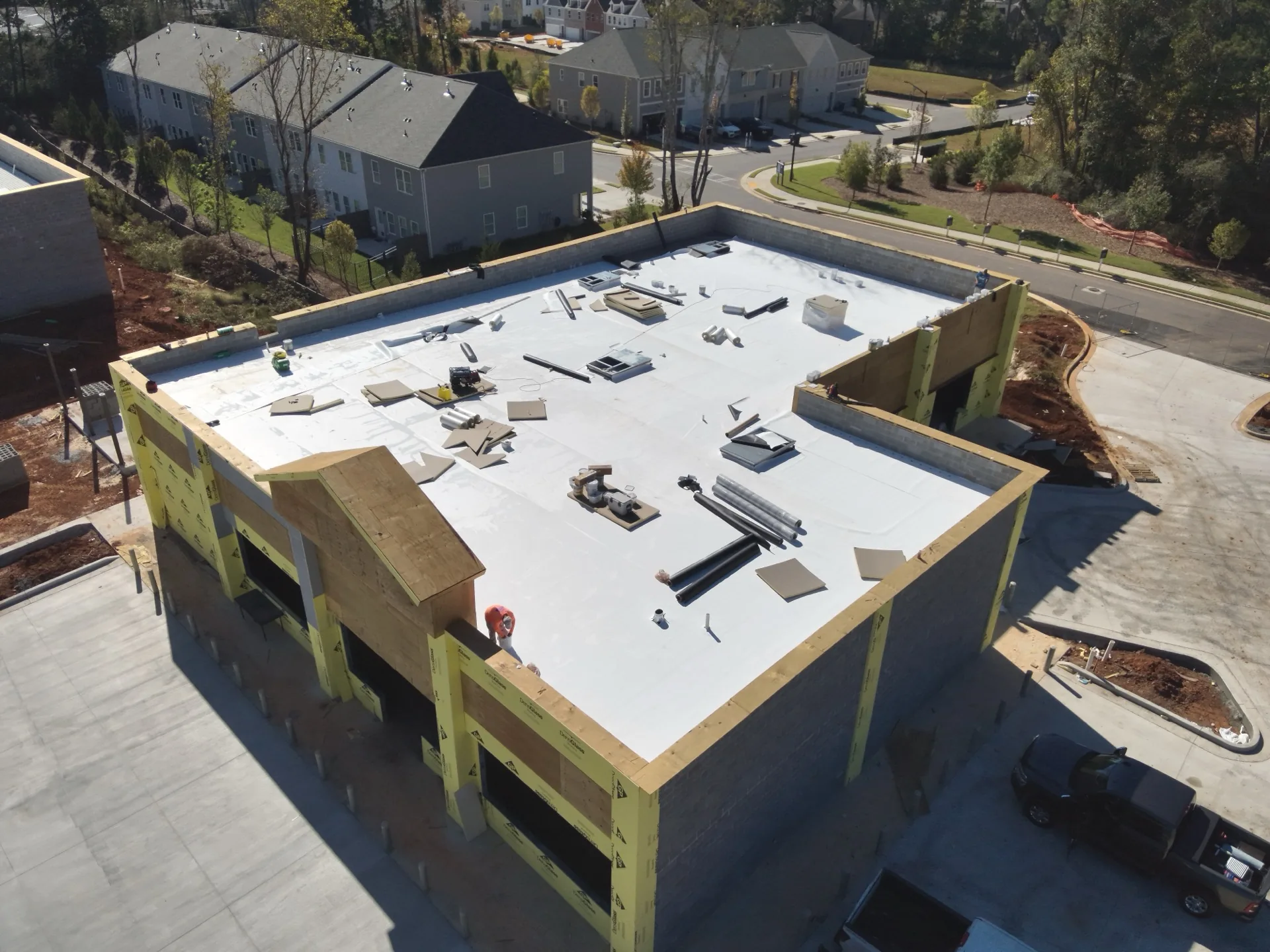
The photograph above shows white single-ply field membrane during an active commercial roof installation. It is first-party field-process evidence from Integrity CRR’s project library; the client and location are withheld.
The image does not identify TPO, PVC, or EPDM. It also cannot establish the manufacturer, product, thickness, attachment below the visible surface, insulation, cover board, deck condition, completed seam testing, final acceptance, or an issued warranty. Those facts require the approved submittal, field records, and closeout documents.
TPO, EPDM, and PVC: the Short Answer
| Membrane category | What distinguishes it | What a proposal still must identify |
|---|---|---|
| TPO | A thermoplastic single-ply category; selected systems use heat-welded membrane seams | Exact product, thickness, attachment configuration, substrate, insulation, cover board, details, approval listing, and warranty path |
| PVC | A thermoplastic single-ply category; a product data sheet should state the composition, installation methods, and exposure limitations of the exact membrane | Exact product and written project-specific compatibility review where rooftop discharges, grease, oils, or chemicals are concerns |
| EPDM | A thermoset rubber category; seam, flashing, and attachment components are manufacturer-specific | Exact reinforced or non-reinforced product, color, attachment, seam system, accessories, approval listing, and warranty path |
Use these descriptions as a starting point; performance rankings require product- and assembly-specific evidence. Carlisle’s single-ply membrane overview, for example, distinguishes thermoset EPDM from thermoplastic TPO and PVC and describes different joining methods. Its Sure-Flex PVC data sheet identifies that specific product as heat-weldable. Neither document makes every product or assembly interchangeable.
Compare the Whole Assembly, Not Just the Acronym
GAF’s commercial document library separates smooth, fleece-back, mechanically attached, adhered, induction-welded, and hail-focused configurations within its TPO and PVC offerings. That is direct evidence that “TPO roof” or “PVC roof” is not a complete specification.
Require each bidder to complete the same assembly schedule:
| Decision | Information needed for a comparable bid |
|---|---|
| Existing construction | Roof layers, deck type, observed moisture or testing limits, drainage, and conditions not verified |
| Removal or recover | Areas removed or retained, preparation, temporary protection, disposal, and concealed-condition assumptions |
| Air and vapor control | Proposed components, transitions, and the project-specific design basis |
| Insulation and cover board | Product, thickness, layer layout, taper, attachment, and transitions |
| Attachment | Field, perimeter, and corner configuration with the applicable design or approval basis |
| Membrane | Manufacturer, product, thickness, color, reinforcement, sheet configuration, and accessories |
| Details | Curbs, drains, scuppers, walls, penetrations, expansion joints, edge metal, and tie-ins |
| Quality records | Submittals, observations, photographs, tests, punch records, and closeout documents |
| Warranty | Sample form, eligible assembly, inspections, application steps, exclusions, maintenance duties, and issued document |
Membrane thickness matters only in context. A thicker sheet does not correct wet insulation, an unsuitable attachment design, omitted cover board, unresolved drainage, or incomplete perimeter details.
Let Building Use Narrow the Shortlist
Mule-Hide’s design-professional guidance says product selection and specifications should be based on project criteria and separately organizes EPDM, TPO, and PVC resources. Translate “project criteria” into written building facts before asking for a recommendation.
Restaurants and Process Exhaust
Do not select PVC merely because a building has a kitchen, and do not assume another membrane is compatible because a generic chart says so. Identify the actual rooftop exhaust, grease, oils, cleaning agents, process chemicals, condensate, and other discharges. Provide the product names, safety data, locations, and expected exposure to the designer and membrane manufacturer, then obtain written compatibility and detail requirements for the proposed product.
Warehouses, Retail, and Office Buildings
Document operating hours, inventory sensitivity, tenant access, loading routes, rooftop equipment, service traffic, solar equipment plans, penetrations, and future curb changes. These facts affect phasing, temporary protection, walkway or cover-board decisions, details, and maintenance access. They do not automatically choose a polymer.
For an occupied distribution property, use the Norcross warehouse reroof planning guide to compare operations, schedule, permitting, budget, and closeout assumptions.
High-Humidity, Cold-Storage, and Sensitive Interiors
Interior temperature, humidity, pressure relationships, air leakage, vapor drive, and deck conditions can change the enclosure design. These buildings deserve project-specific design review rather than a membrane-only rule. Ask who is responsible for the air and vapor analysis and how roof-to-wall, penetration, and equipment transitions are documented.
Reflectivity Is a Rated Property, Not a Savings Promise
Color alone is an incomplete energy comparison. The U.S. Department of Energy’s cool-roof purchasing guidance is technology-neutral, advises buyers to examine solar reflectance, retention of reflectance, and emittance, and notes that savings depend on heating and cooling loads.
If reducing solar heat gain is a project goal, compare the exact products’ rated properties and aged values alongside the insulation design, climate, HVAC operation, and building-use assumptions. Do not convert a white membrane or a modeled scenario into a guaranteed utility-bill reduction.
Wind, Hail, and Traffic Are Assembly Questions
Do not rank TPO, EPDM, and PVC for wind or hail from polymer folklore. Compare the complete proposed assembly: deck, fasteners or adhesive, insulation, cover board, membrane, field/perimeter/corner layout, edge system, and details. Ask for the applicable code or design basis and the exact tested or approved listing.
FM Approvals explains that products and services earning its approval are tested and listed in its Approval Guide and RoofNav. Where an FM requirement applies, the current project-specific RoofNav assembly and its limitations are more useful than a claim that one membrane category is always “hail-proof” or “strongest.” GAF’s document library likewise publishes separate hail-focused configurations, reinforcing that the complete selected assembly must be evaluated.
Foot traffic is also a system and operations issue. Identify access routes, service frequency, dropped-tool or equipment risks, and proposed walkways or protection. The bid should state what is included rather than promising that one membrane category tolerates every use.
Recover or Tear-Off Comes Before Product Preference
A recover may be possible when the existing construction and proposed assembly qualify; it is not an automatic cost-saving option. GAF’s roof-recover guidance identifies existing roof count, structural condition, moisture or deterioration, and upgrade requirements as considerations.
Require the investigation record to state what was tested, what was observed, and what remains concealed. The Atlanta TPO planning guide explains recover versus tear-off, attachment, drainage, permits, and warranty review without assuming TPO is the answer.
Replace Generic Prices and Lifespans With Bid Evidence
An unsourced price per square foot hides the variables that usually separate bids. A generic service-life range is equally weak without an exact product, assembly, exposure, installation record, maintenance plan, repair history, and definition of failure.
Use a bid worksheet instead:
| Bid category | Require this level of detail |
|---|---|
| Measured quantities | Roof plan, areas, perimeters, walls, drains, curbs, penetrations, and alternates |
| Removal and concealed work | Known quantities, unit prices, measurement rules, allowances, and written authorization process |
| Assembly | Every retained and new layer, attachment method, thickness, taper, and transition |
| Operations | Access, loading, interior protection, work zones, equipment coordination, and daily dry-in responsibilities |
| Schedule | Production assumptions, weather limits, inspections, dependencies, and closeout, with no fixed marketing promise |
| Warranty and maintenance | Sample form, eligibility, inspections, exclusions, owner duties, application, and issued document |
Ask bidders to price the same baseline and separate alternates. Then the owner can see whether a lower number reflects a different membrane, thinner or omitted components, fewer details, an assumed recover, an allowance, or a genuinely lower price for equivalent scope.
A Six-Step Selection Process
- Document the existing roof, deck, moisture limits, drainage, details, rooftop equipment, building use, and operating constraints.
- Define project criteria, including code, wind or insurer requirements, exposure concerns, energy goals, service traffic, phasing, and warranty expectations.
- Request complete candidate assemblies rather than membrane-only recommendations.
- Verify current product data, compatibility, details, approval listings, and manufacturer requirements for each candidate.
- Compare itemized bids against one baseline scope, with assumptions, exclusions, unit prices, alternates, and schedule logic exposed.
- Preserve the approved submittal, field records, inspection and test documents, maintenance information, and issued warranty at closeout.
What Integrity CRR Can Document
Integrity CRR self-performs roofing with its own crews and prepares roofing estimates in-house. For non-roof scopes, the company acts as general contractor and manages vetted subcontractors. The commercial roofing service page explains that operating model and the systems currently offered.
The Projects library contains original field photographs with explicit limits on what each image proves. For a building-specific comparison, send the roof plan, known assembly, leak or repair history, prior warranty, rooftop-equipment list, access constraints, and project goals through the contact page. The investigation and written proposal control the recommendation; this general guide cannot.
Frequently Asked Questions
Is TPO or EPDM better for a commercial roof?
Neither is universally better. Compare complete candidate assemblies against verified deck, moisture, drainage, attachment, building-use, exposure, approval, maintenance, and warranty requirements. The membrane name alone cannot decide the project.
Should a restaurant automatically use PVC roofing?
No. First identify the actual exhaust, grease, oils, cleaning agents, chemicals, condensate, and discharge locations. Ask the designer and manufacturer for written compatibility and detail requirements for the exact proposed product before selecting it.
Does a white TPO or PVC roof guarantee lower utility bills?
No. Compare rated solar reflectance, retained reflectance, and emittance for the exact product with the insulation, climate, HVAC, and building-use assumptions. A reflective surface can be one input, but it is not a utility-savings guarantee.
Which membrane handles hail best?
Do not choose from a generic polymer ranking. Compare the complete tested or approved assembly, including deck, attachment, insulation, cover board, membrane, perimeter and corner design, edge system, and the limitations in the current listing.
How much do TPO, EPDM, and PVC roofs cost?
A credible comparison requires measured quantities and the same baseline for removal, concealed deck work, insulation, cover board, attachment, drainage, details, operations, permits, warranty, and closeout. Product labels or unsourced market ranges do not make bids comparable.
How long do TPO, EPDM, and PVC roofs last?
There is no responsible universal answer. The exact product and assembly, design, exposure, workmanship, inspections, maintenance, repairs, rooftop traffic, and definition of serviceability all affect the result. Review product-specific documents and the issued warranty without treating warranty duration as predicted service life.
Can a new membrane be installed over the existing roof?
Sometimes. A recover depends on existing roof count and condition, moisture and deterioration findings, deck and structural considerations, attachment, current code, local permit review, manufacturer requirements, and project goals. A building-specific investigation should support the recommendation.
Does contractor certification guarantee a manufacturer warranty?
No. Certification and warranty issuance are different. Confirm the current program record, exact eligible assembly, required inspections, application steps, exclusions, maintenance duties, and the final issued document for the project.
Comparing commercial roof systems for a Georgia property? Call (833) 423-6255 for current availability or send the building and roof information through the estimate request.